Discovery is scaling.
Manufacturing isn’t.
A very small team can now reach a candidate medicine. Making it reliably and affordably still takes a plant, a process and people who get it right first time. Anywhere Bio fixes the making: partner labs run like factory floors first, then our own devices, then a fully automated floor. We start with peptides, proteins and essential medicines.
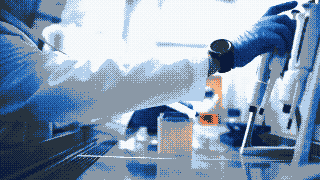
The industry today
How a batch moves through a well-run floor. Six steps, one record.
Whatever the molecule, a batch goes through the same kind of steps. At each one, a skilled person makes a decision that saves a day or loses a week. That is where the first level of optimisation lives.
PlanStep 1 of 6
Plan the batch
Every batch starts on a schedule: which room, which instruments, which operators, and when each step hands over to the next.
The decisionA schedule that fits rooms, instruments and people, with no step waiting on another.
Animation: bars fill a schedule board, one row per room, without overlapping.
Stage the materials
Released materials are checked and staged at the line, so nobody stops halfway through a step to go and find something.
The decisionEverything checked and in place before the work starts.
Animation: items move onto a staging tray and each one is ticked off.
Run the step
The product is made in a controlled step, with every setting and reading written into the batch record as it happens.
The decisionFollow the process exactly, and spot drift before it becomes a deviation.
Animation: a reading is plotted inside a control band while a vessel runs.
Check in process
In-process checks confirm the step did what it should before the batch moves on, so problems are caught in hours rather than weeks.
The decisionJudging a result against the specification, and stopping early when it misses.
Animation: a trace is drawn with several peaks and the target peak is shaded and accepted.
Fill and seal
The product is filled into vials, sealed and labelled under sterile conditions.
The decisionClean technique under pressure: one slip can lose the batch.
Animation: a vial fills, is capped and labelled, and moves along a belt.
Test and release
Sterility, identity, purity and potency are tested before the batch is released.
The decisionRight first time means no re-test and no lost week.
Animation: four tests pass one by one, then the batch is marked released.
Same rooms, same licences. Run like a factory floor.
Most of the gain at Level 1 is not new science. It is process, instruments, trained people and layout. Choose a view to compare.
Route: Run, then Investigate, then Re-run.
- Process
- Written by each lab its own way
- Instruments
- General-purpose, shared between projects
- People
- Trained on the job, retrained after errors
In a McKinsey study of pharma sites, median equipment effectiveness was 32%.1 The FDA names the lack of reward for mature quality management among the root causes of US drug shortages.4
Three levels of optimisation, each one paying for the next.
We do not start with a robot. Each level produces the evidence and the batch record the next one needs, and each has a gate it has to pass.
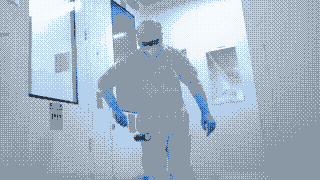
Process, people and instruments
Level 1 · Forming now
We partner with labs that already have the rooms and licences and upgrade them: one standard process, better instruments, trained operators, and a floor laid out and run like a factory.
Proves: right-first-time batches, shorter cycles, lower cost per batch.

Our own devices
Level 2 · Up next
Where the batch record shows a step that bought instruments do badly, we design and build our own in house and put them on the same floors.
Proves: the same batch, faster and cheaper, on our hardware.
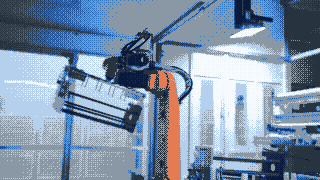
A fully automated floor
Level 3 · Planned
Robotics and software run the routine steps, with people supervising, trained on the record the first two levels built.
Proves: automated batches a regulator accepts.

Advanced medicines
Then · Long term
With cost and reliability proven on simpler molecules, the same floors take on mRNA and personalised cancer vaccines, the medicines that today cost the most to make.
Proves: advanced medicines at a price health systems can pay.
Where the industry is heading: automated floors.
Lilly and NVIDIA have committed up to $1 billion to link AI with automated wet labs, with manufacturing in scope.7 The FDA now offers early engagement for advanced manufacturing technologies.8 Level 1 earns the batch record that Levels 2 and 3 are built on; it does not skip to the robot.
Who it is for. Three ways in.
Drug developers
- What we are building
- GMP batches of your peptide, protein or small-molecule candidate, made on partner floors we run to one standard. Built for small teams that have a molecule and no plant.
- Tell us
- Your candidate: molecule type, stage, batch size, when you need it.
Partner labs
- What we are building
- A standard process, upgraded instruments, trained people and demand for the rooms and licences you already have.
- Tell us
- What your rooms, licences and team look like today.
Lab professionals
- What we are building
- Training and certification for each step on the floor, and a place to use it. Skilled operators are what make a floor run right first time.
- Tell us
- Your background and the steps you have run.
Why start with simpler molecules.
Peptide demand from GLP-1 medicines has put unprecedented pressure on manufacturing capacity built for much smaller volumes.6 Half the people who need insulin for type 2 diabetes do not get it.3 Meanwhile AI agents can already analyse tens of thousands of trials and propose candidates.9 The science is not the bottleneck. Making is.
Peptides, proteins and essential medicines have proven methods and present demand. They are where a floor run right first time pays back soonest, and where we build the record that advanced medicines will need.
Built from India, where cost decides who gets treated.
India has shown it can bring an advanced therapy to patients by making it here, at a tenth of the international price. Cost per batch is the number we are working on, and India is where it can fall furthest, and where skilled operators are ready to be trained.
Have a candidate that needs a batch?
We are talking to drug developers, GMP-capable labs and lab professionals now. Write to us with what you are making and when you need it.